Build an Airtable Portal for Animal Shelters and Rescue Organizations
Give foster parents self-service access to their animals, medical records, supplies, and availability surveys, all connected to your Airtable base.

See it working, then start from a ready-made Airtable base.
See a live demoCopy the Airtable templateThe Problem: Keeping Foster Parents in the Loop
Animal shelters and rescue organizations run on volunteers. Foster parents take animals home, administer medications, track weight changes, and submit progress updates. But coordinating all of this is a constant challenge.
Your staff manages everything in Airtable: animal records, medical events, foster assignments, supply tracking, and availability surveys. The problem is getting that information to your foster parents without:
- Adding them as Airtable collaborators, at $20/month per user, giving 80 foster parents access would cost $1,600/month. Most shelters cannot justify that.
- Sending email updates, foster parents email back with questions about information you have already updated. Staff spends hours answering questions that a self-service portal would eliminate.
- Using shared documents, no privacy between foster homes. One foster parent can see another's address, medical notes, and animal assignments.
- Printing packets, outdated the moment you hand them out. Vaccine schedules, medication changes, and task assignments change daily.
What you need is a portal where foster parents can log in, see just the animals assigned to them, update weights and photos, check supply availability, and submit availability surveys, all syncing directly back to your Airtable base.
How CollabPortals Solves This
CollabPortals connects to your existing Airtable foster database and creates a branded portal for your foster parents. Each foster parent logs in with their email, and CollabPortals matches them to their record in your Foster Home Database table. They only see animals and data linked to them.
A Typical Foster Portal Setup
Based on how animal shelters actually organize their Airtable bases, here is what a foster portal typically looks like:
| Table | Foster Access | What It Does |
|---|---|---|
| Animals In Foster Care | View, edit | Foster parents see their animals, upload photos, update weights |
| Foster Home Database | View, edit | Foster parents manage their own contact info and preferences |
| Medical Event Tracking | View only | Foster parents check vaccine schedules and medical history |
| Supply Inventory | View only | Foster parents see what equipment is available |
| Item Reservations | Create, edit | Foster parents reserve and return crates, carriers, and supplies |
| On Deck Survey | Create, edit | Foster parents submit availability for new placements |
| Report Cards | Create | Foster parents submit progress updates on their animals |
| Tasks | View, edit | Foster parents see and complete assigned tasks |
| Staff & Volunteers | Hidden | Internal staff directory stays private |
| Program Calendar | Hidden | Internal scheduling stays private |
Field-Level Control
Within each table, you decide exactly what foster parents see. For the Animals table, you might show Name, Photo, Current Status, Gender, Age, Vaccines Due, and Weight, but hide internal fields like Outcome Status, Animal Notes, LOS In Foster, and Cost data.
For the Foster Home Database, show contact fields (Name, Email, Phone) as editable, show Current Foster Animals as a read-only linked record, and hide internal fields like Level, Labels, Internal Notes, and Full Address.
Smart Permissions for Sensitive Data
Animal shelter data includes sensitive information: medical records with treatment costs, foster parent addresses, internal notes about animal behavior issues, and outcome tracking. CollabPortals lets you expose only what foster parents need:
- Medical records: show vaccine dates and types, hide cost and billing fields
- Foster profiles: let foster parents update their own phone and email, hide address fields and internal notes
- Animal records: show photos, status, and care instructions, hide outcome tracking and internal assessments
Build a Foster Portal Step by Step
Here is how the live demo above is put together. It takes about an hour the first time, with no code involved.
- 1
Set up your Airtable base
Start with your foster database: an Animals In Foster Care table for the animals out on placement, Medical Event Tracking for vaccines and treatments, a Supply Inventory, a Tasks table, Documents, and a Foster Home Database for the foster parents who log in. The Foster Home Database is the hub. It holds each foster parent's email, and the animals link back to it, so each foster only ever sees the animals in their own home.
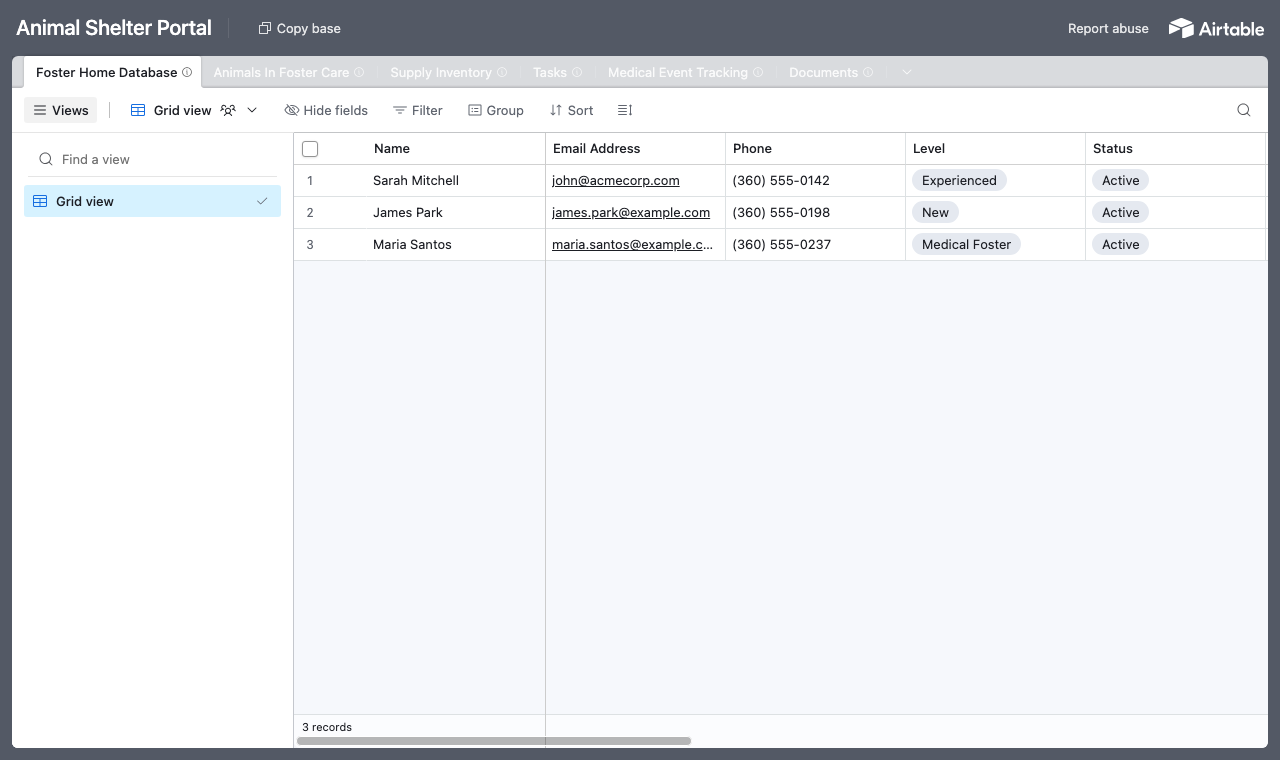
A table for each part of the programme, with a Foster Home Database every animal links back to. - 2
Connect the base and pick the user table
Point CollabPortals at that base, then choose Foster Home Database as your user table and Email Address as the login field. Each foster parent signs in with their email and is matched to their own record.
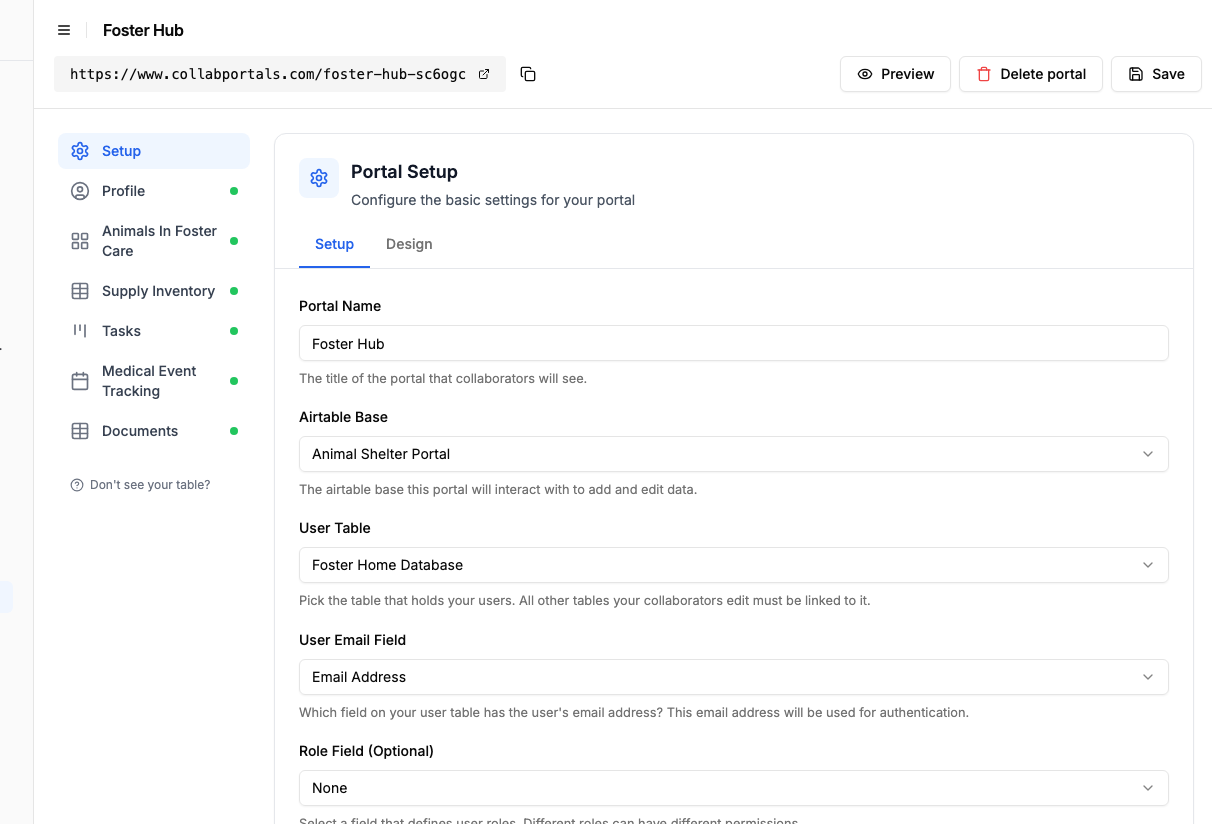
Connect the base, then point CollabPortals at the Foster Home Database and its email field. - 3
Let fosters update their animals, hide costs and outcomes
On the Animals In Foster Care table, turn on edit so foster parents can update a weight or upload a new photo, while leaving create and delete to your staff. Show the fields they care about, name, status, vaccines due and weight, and hide internal ones such as cost data and outcome tracking.
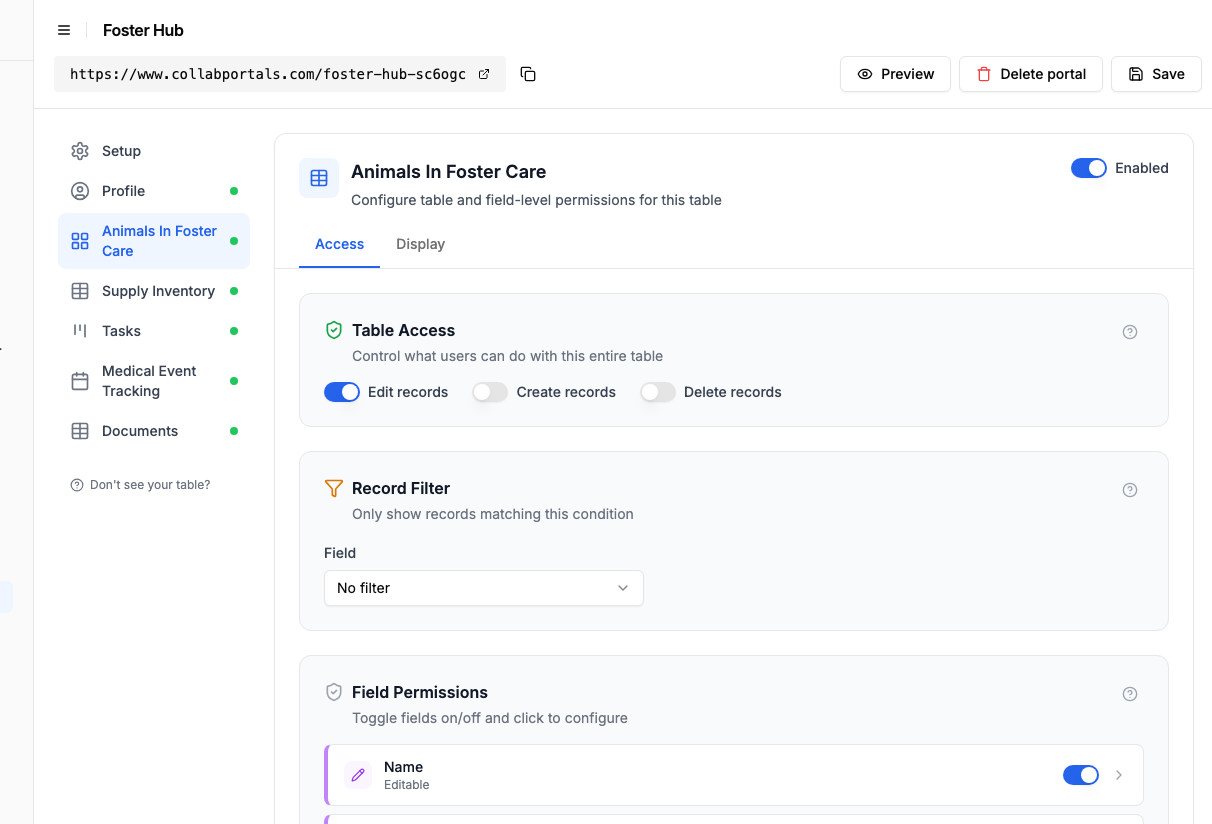
Let fosters update weights and photos, while cost and outcome fields stay hidden. - 4
Give each table the view that fits
Pick how each table appears. Animals In Foster Care as a gallery of photos, Medical Event Tracking on a calendar, Tasks as a board, Supply Inventory and Documents as tables. Same Airtable data, shaped for foster parents.
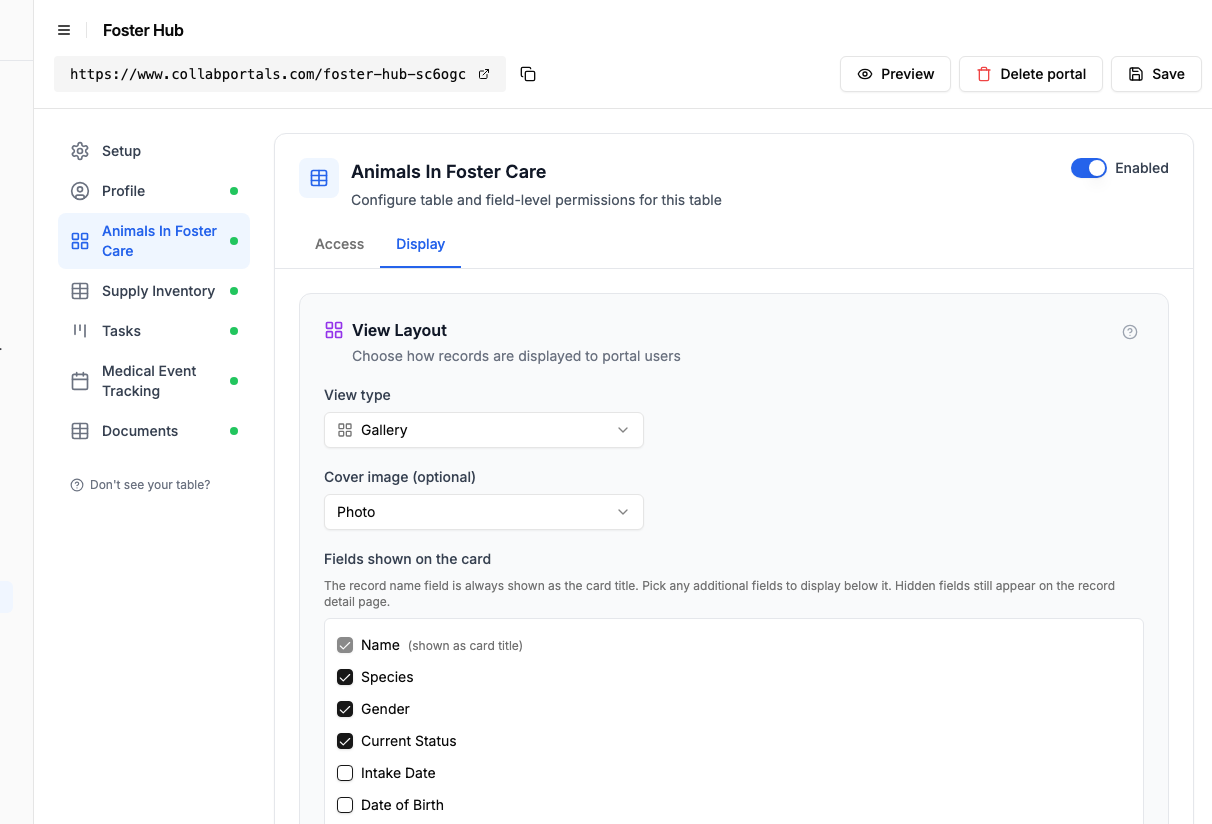
The Display tab lays the animals out as a gallery of photos. - 5
Foster parents get their animals in one place
The result is a clean, branded portal. Each foster parent signs in and sees only the animals in their home, updates weights and photos, checks vaccine schedules, and never sees another foster's address or notes, all syncing straight to your Airtable base.
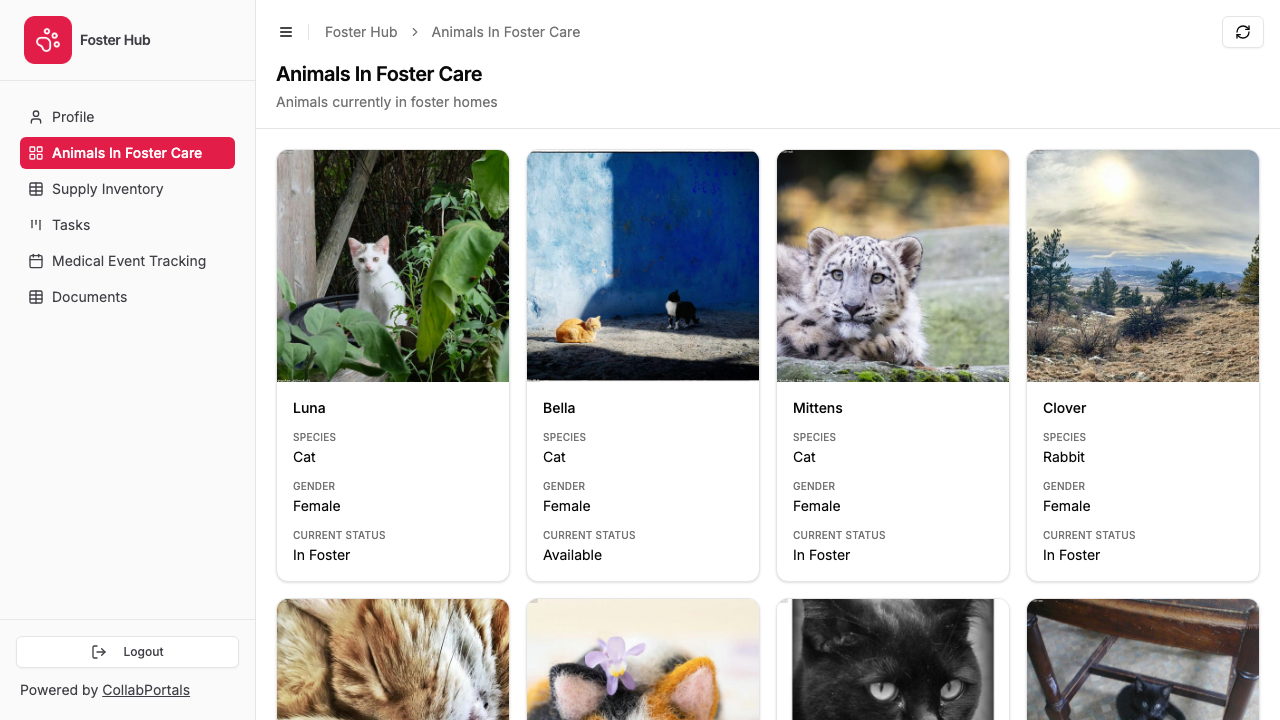
Each foster sees only the animals in their own home, as a gallery they can update. - 6
They log in with their email
Share the link with your foster parents. Each one signs in with their email and a one-time code, so there are no passwords to manage and no Airtable seats to buy.
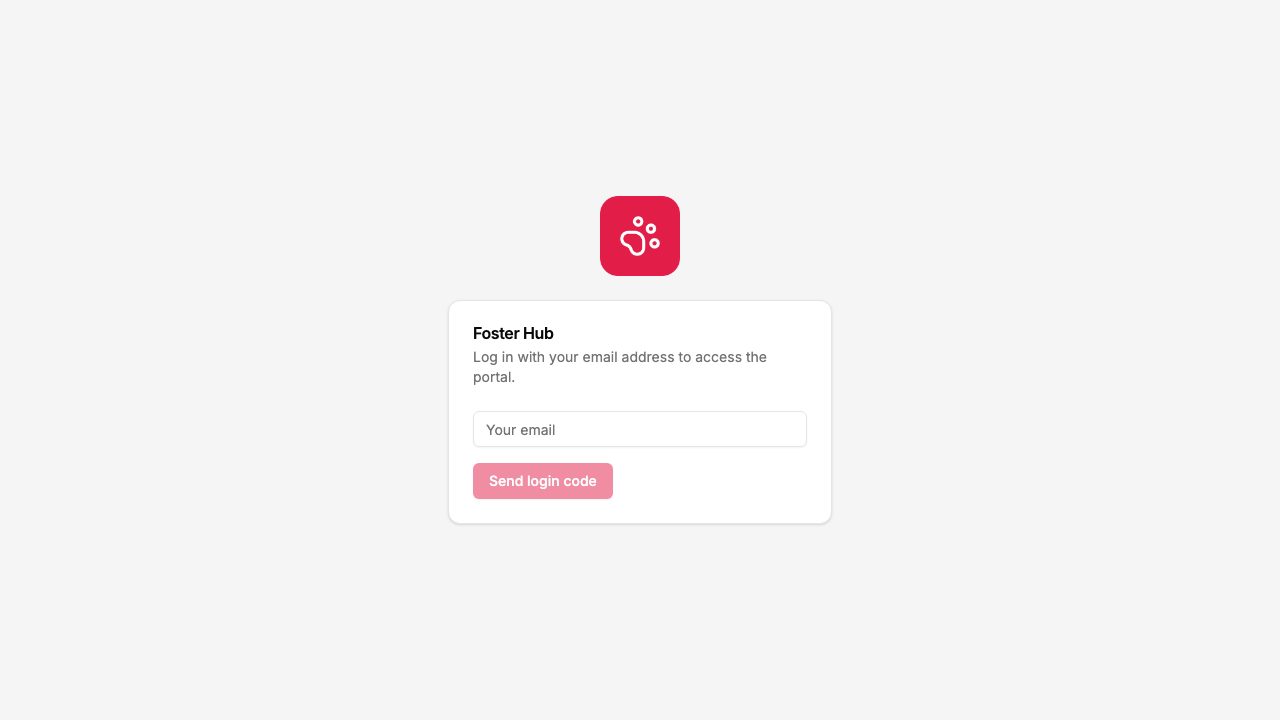
Email and one-time code login, branded with your shelter's logo and colour.
Want to start from this exact setup? Open the live demo or copy the Airtable template and connect it to your own base in minutes.
Real-World Shelter Portal Patterns
The Foster Care Hub
The most common pattern. Foster parents view their assigned animals, check upcoming tasks, and submit progress reports. Staff manages everything in Airtable; foster parents interact through the portal.
What foster parents can do:
- View their assigned animals with photos, status, and basic medical info
- Update animal weight and upload new photos
- View and complete assigned tasks
- Submit report cards and behavioral updates
- Check their own profile and update contact info
The Supply and Equipment Portal
Shelters that lend equipment (crates, carriers, exercise pens, heating pads) to foster parents use the portal for self-service reservations and returns.
What foster parents can do:
- View available inventory
- Reserve items with a date and pickup time
- Log returns when bringing equipment back
- See their current reservation history
The Availability and Matching Portal
Shelters with a structured foster matching process use "On Deck" surveys to collect availability, preferences, and capacity from foster parents before making placements.
What foster parents can do:
- Submit when they are available to foster
- Indicate species and population preferences (kittens, adult dogs, medical cases)
- Note capacity limits (kids in home, other pets, ability to separate animals)
- Specify comfort with special needs (medications, ringworm, behavior challenges)
Why Not Just Use Airtable Forms?
Airtable Forms let you collect data, but they are one-directional. Foster parents can submit information, but they cannot:
- View their own animals or assignments
- See medical records or vaccine schedules
- Update records after submission
- Check supply availability
| Capability | CollabPortals | Airtable Forms |
|---|---|---|
| View linked records | Yes | No |
| Edit existing records | Yes | No (new submissions only) |
| Per-user data privacy | Yes, matched by email | No user concept |
| Read + write in one place | Yes | Write only |
| Cost for 80 foster parents | $10/month | Free (but very limited) |
Take It Further
The walkthrough above is the whole build. A few options are worth knowing once you are up and running:
- Report cards and surveys. Add create access to a progress-report or availability table so foster parents submit updates and signal when they can take a new placement.
- Item reservations. Let fosters reserve crates and carriers from your supply inventory, so equipment check-out runs itself.
- Editable profiles. Give the Foster Home Database edit access so foster parents keep their own phone and email current, while their address and internal notes stay hidden.
- Nest medical history under each animal. Turn on related tabs so an animal's medical events, report cards and tasks show as tabs on the animal record, scoped to it, instead of separate tables a foster has to cross-reference.
After the first day of set-up, every weight, photo and update a foster logs lands straight in your Airtable base, where your staff already works.
For the generic version that applies to any base, see the setup guide.
Frequently Asked Questions
How do foster parents log in?
Foster parents enter their email address and receive a verification code. CollabPortals matches their email to a record in your Foster Home Database table, so they only see animals and data linked to them. No passwords to manage.
Can foster parents see other foster parents' animals?
No. Each foster parent is matched to their own record in your Foster Home Database. They only see animals, tasks, and reservations linked to their record. Other foster parents' data is completely invisible to them.
Can we use roles to give different access levels?
Yes. CollabPortals supports roles. If your Foster Home Database has a "Level" field (e.g., New, Experienced, Medical Foster), you can configure different permissions for each level. Experienced fosters might see medical records while new fosters see only basic animal info.
Can foster parents upload photos and documents?
Yes. If you enable edit permissions on an attachment field (like "Photo" on the Animals table), foster parents can upload files directly through the portal. The attachments sync back to your Airtable base immediately.
Does this work with our existing Airtable base?
Yes. CollabPortals connects to your existing base. You do not need to restructure anything. Just make sure you have a table with foster parent records (including email addresses) and linked record fields connecting fosters to their animals.
How much does it cost?
$10/month for unlimited users and unlimited portals. There is no per-foster-parent charge. Whether you have 10 or 200 foster parents, the price is the same.
What if a foster parent returns all their animals?
They can still log in and see their profile. If you want to remove access entirely, deactivate or remove their record from your Foster Home Database. Since authentication is based on email matching, they will no longer be able to log in.

About the author
Matt Shepherd
Founder, CollabPortals
Matt is the founder of CollabPortals. A software engineer and Airtable power user who kept running into the same frustration: no easy way to give external users a simple and secure view to edit their data. He built CollabPortals as the lightweight solution to that problem, allowing you to set up a secure, permissioned portal in a few clicks.
Related use cases and guides
Nonprofits
Give donors, volunteers, beneficiaries, and board members secure access to the data they need, without Airtable seats or custom development.
Use caseVolunteers
Give volunteers self-service access to their assignments, schedules, and tasks. No extra Airtable seats, no code, no passwords to manage.
ComparisonCollabPortals vs Airtable Portals: Third-Party Tool or Native Feature?
Compare CollabPortals ($10/month, unlimited users) with Airtable's native Portals, where read-only guests are free and editing guests are sold in packs from $120/month. See which fits how your users actually work.
ComparisonCollabPortals vs Softr: Lightweight Portal or Full App Builder?
Compare CollabPortals and Softr for Airtable portals. See how a $10/month focused portal tool stacks up against a full no-code app builder starting at $49/month.